
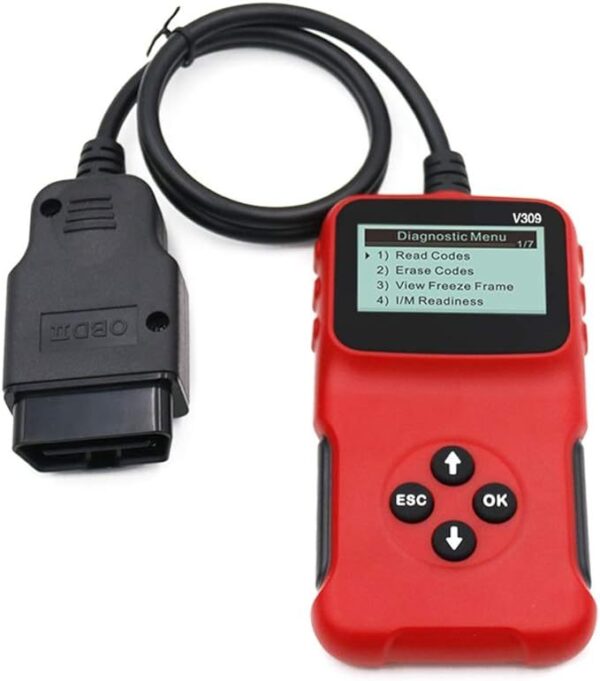
V309 OBD2 Car Diagnostic Scanner and Code Reader — a plug-in OBD2 code reader that reads and clears engine fault codes, so a warning light can be diagnosed without a trip to a workshop. It also tests battery voltage, which is worth having because a weak battery is one of the commonest causes of fault codes that appear for no obvious reason.
Why it is worth fitting
An engine management light comes on and the car gives you nothing to work with: no fault, no code, no explanation, just a lamp and a decision about whether it is safe to drive. A code reader turns that into information. Plug it into the diagnostic port under the dashboard, read the code, and you know whether it is a loose fuel cap, an oxygen sensor or something that needs the car off the road. That single piece of information decides whether you are booking a workshop visit at all. The battery tester is the addition that saves the most wasted effort: a battery on its way out causes voltage dips that the engine management system reads as sensor faults, which is why so many intermittent codes are chased for weeks when the real problem is a dying battery.
Key features
- Reads and clears OBD2 and EOBD diagnostic trouble codes
- Built-in battery tester that checks voltage and charging health
- Works with all OBD2 and EOBD compliant vehicles
- Powered directly from the OBD port, so there is no internal battery to charge
- Digital LCD screen that displays the code and its description plainly
- Nine display languages, including English, Spanish, French, German, Portuguese and Russian
- USB connectivity for updates and data transfer
- Reads and clears codes, so you can confirm whether a fault has actually been fixed
Specifications
| Model number | V309 |
|---|---|
| Type | Car diagnostic scan tool / code reader |
| Functions | Read and clear OBD codes, battery tester |
| Communication interface | OBD |
| Power source | OBD port (no internal battery required) |
| Operating voltage | Up to 36 V, for 12 V vehicle systems |
| Display | Digital LCD |
| Connectivity | USB |
| Languages | English, Spanish, Japanese, Simplified Chinese, Bulgarian, French, Russian, Portuguese, German |
| Supported vehicles | All OBD2 / EOBD compliant cars |
| Colour | Red |
| Country of origin | Guangdong, China |
Will it fit?
Universal on petrol cars sold from roughly 2001 and diesel cars from roughly 2004 in the EU, which are the dates OBD2 and EOBD conformance became mandatory. The connector is under the dashboard, usually within 60 cm of the steering column but occasionally behind a panel or in the centre console. An important limit to understand: it reads engine and emissions codes. It does not read manufacturer-specific systems such as ABS, airbag or body control modules, which need a more specialised tool.
Fitting and first use
With the engine off, find the diagnostic socket — usually under the driver’s side dash. Plug the reader in; it powers up from the port, so there is nothing to switch on. Turn the ignition to the on position, without starting the engine, and let the tool connect. Read the codes and write them down before clearing anything: the stored codes and freeze-frame data are the history of the fault, and once cleared they are gone. Clear the codes only after you have recorded them, then drive the car and see whether the lamp returns. If it comes straight back, the fault is present rather than intermittent.
Care and maintenance
Store it in the glovebox with the cable looped loosely rather than folded sharply at the connector, which is the part that fails first. Keep the OBD plug clean and dry. If the screen is faint, check the vehicle battery first, because low voltage from a failing battery also affects the tool. Never clear codes immediately before a roadworthiness inspection — readiness monitors need drive cycles to reset, and a car with unready monitors can fail on that alone.
Frequently asked questions
Will it work on my car?
On any petrol car from roughly 2001 and diesel from roughly 2004 in the EU, which is when OBD2 and EOBD became compulsory. Older vehicles and some non-EU imports may use a different protocol.
Can it read ABS or airbag faults?
No. It reads engine and emissions codes. ABS, airbag and body control faults need a tool that supports those specific systems, and often a manufacturer-specific one.
Does clearing a code fix the fault?
No. Clearing a code turns the warning light off and erases the record. If the underlying fault is still present the code will return, which is itself useful information.
Should I clear codes before selling or before an inspection?
No. A readiness monitor needs drive cycles to reset after codes are cleared, so an inspection can fail on that basis. Clearing codes also removes diagnostic history that a buyer or a technician would want.
SKU: AP-017 | Category: OBD2 Scanner
Delivery is a flat €12 per order. See our Returns & Exchanges page for delivery times, your 14-day right of withdrawal and the 2-year legal guarantee of conformity.
Reviews
There are no reviews yet.