
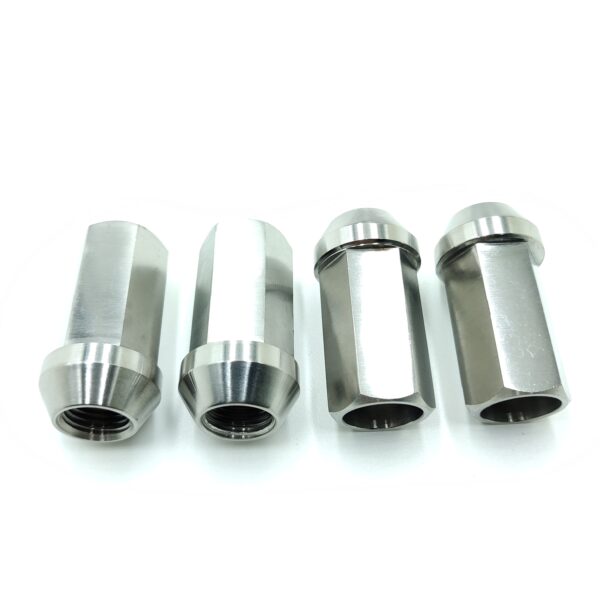
GR5 Titanium Wheel Lug Nuts, M14, Hex Head, CNC Machined — CNC-machined titanium lug nuts in M14, grade 5, with a hex head and a polished, anodised or black-oxide finish. They are bought mainly for weight and appearance — titanium is roughly 40% lighter than the steel equivalent, which matters to anyone counting unsprung mass — and this is a specialist fastener rather than a general replacement part.
Why it is worth fitting
Lug nuts are almost always bought for one of two reasons: to replace damaged or missing originals, or to change the look of the wheels. This is the second kind. Titanium is roughly 40% lighter than steel, so a set reduces unsprung and rotating mass slightly, and the finish options — polished, anodised or black oxide — give a visible difference on a car with open or exposed wheel bolts. CNC machining is the part that matters for quality: a machined nut has a consistent thread and a consistent seat, whereas a cheap cast nut can be slightly out of true and will not torque down evenly. That said, this is a specialist fastener and should be treated as one: it is a weight and appearance choice, not an upgrade in strength over the steel nut it replaces.
Key features
- GR5 titanium alloy — approximately 40% lighter than the equivalent steel nut
- CNC machined rather than cast, so the thread and the seat are consistent
- Choice of black oxide, polished or anodised finish
- Hex head profile with a stated flange diameter of 19.7 mm
- Right-hand thread
- ISO 9001:2008 certified production
- Reduces rotating and unsprung mass slightly when fitted as a full set
- Available in natural titanium or anodised colours
Specifications
| Brand | PRECISION |
|---|---|
| Product type | Titanium wheel lug nut |
| Grade | GR5 / Class 10 |
| Thread size | M14 |
| Hole diameter | 14 mm |
| Flange diameter | 19.7 mm |
| Head type | Hex |
| Thread direction | Right hand |
| Material | Titanium / titanium alloy |
| Surface treatment | Black oxide, polishing, anodizing |
| Colour | Natural titanium, or anodised colours |
| Production method | CNC machining |
| Certificate | ISO 9001:2008 |
| Country of origin | Shaanxi, China |
Will it fit?
M14 on its own is not a complete specification, and this is the point where buying the wrong part becomes a safety matter rather than an inconvenience. Three things must be established before ordering. The thread pitch: M14×1.5 and M14×2.0 are both in common use and are not interchangeable. The seat type: conical at 60 degrees, ball or radius, and flat seats are all used, and fitting the wrong seat means the nut will not hold the wheel correctly. And the stud length, since the nut must engage enough thread. Send us the vehicle make, model and year, or the details from an existing nut, and we will help confirm the specification before you order.
Fitting and first use
Never fit wheel nuts without knowing the required torque figure for your vehicle, and always tighten with a torque wrench rather than by feel. Clean the stud threads and the wheel seat of dirt and corrosion before fitting, and do not lubricate the threads unless the manufacturer specifies it, since oil changes the torque you need. Fit the nuts finger-tight first, then tighten in a star or diagonal sequence in stages rather than taking each one straight to full torque. Check the torque again after roughly 50 to 100 km of driving, and after any wheel removal. Wheel nuts are safety-critical fasteners and the sequence matters as much as the figure.
Care and maintenance
Check the torque again after any wheel removal and periodically thereafter. Avoid impact wrenches on titanium nuts: an impact gun applies shock loads and does not measure torque, and both are hard on a fastener of this type. Clean the threads and the seat when you change a wheel, and keep the seat surfaces free of grit and corrosion. Do not use a copper-based grease on a titanium nut unless specifically advised, since dissimilar metals can interact. Inspect them for galling, which appears as a rough or picked-up thread surface, and replace any nut that shows it.
Frequently asked questions
Which thread pitch do I need?
That depends entirely on the vehicle. M14×1.5 and M14×2.0 are both common and are not interchangeable. Send us your make, model and year, or the details from an existing nut, and we will help confirm.
What seat type are these?
Seat type must be confirmed against your wheel, because conical, ball and flat seats are all in use and fitting the wrong one will not hold the wheel correctly. Contact us before ordering.
Are titanium nuts stronger than steel?
Not necessarily. Titanium is lighter and titanium nuts are bought for weight and appearance. They should be treated as a specialist fastener rather than an upgrade in strength over the steel nut they replace.
Are they road legal?
Several European markets require wheel fasteners on road vehicles to meet a strength specification, and some racing sanctioning bodies prohibit non-standard wheel fasteners outright. Check the requirements that apply to your vehicle and its use before fitting.
Please read before ordering
Wheel nuts are a safety-critical fastener and M14 alone is not a complete specification. Before ordering, three things must be confirmed: the thread pitch (M14×1.5 and M14×2.0 are not interchangeable), the seat type (conical 60°, ball or radius, or flat — the wrong seat will not hold the wheel correctly), and the length your studs require. Send us the vehicle make, model and year and we will help confirm the correct specification. Please also note that a titanium nut is a weight and appearance choice; it is not a strength upgrade over the steel nut it replaces. Always tighten wheel nuts to the vehicle manufacturer’s torque figure using a torque wrench, in a star sequence, and recheck after 50–100 km.
SKU: AP-049 | Category: Wheel Lug Nuts
Delivery is a flat €12 per order. See our Returns & Exchanges page for delivery times, your 14-day right of withdrawal and the 2-year legal guarantee of conformity.
Reviews
There are no reviews yet.